
UPDATE: Protests Against Deepening U.S. Involvement in Venezuela Continuing Today
Hit the streets in more than 40 cities against new wars
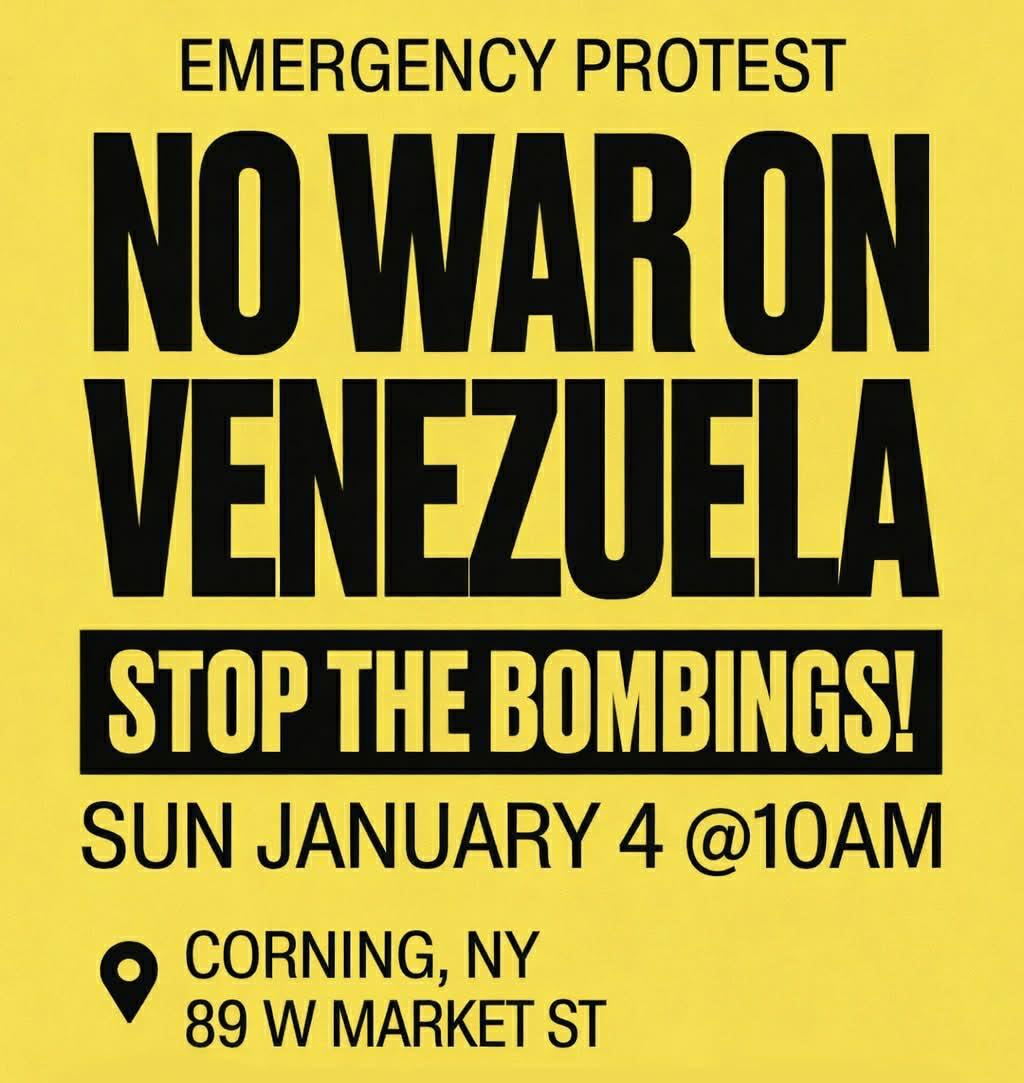
ANTI-WAR PROTESTS ACROSS THE NATION
We will have more to say about the bombings in Venezuela, Trump’s insistence that we will “run the country” temporarily, his plans to seize the country’s oil infrastructure to “revitalize it,” and his threats to put American boots on the ground there and against Colombia, Cuba, Greenland and Mexico in tomorrow’s issue. But there’s plenty of activism well underway to counter this step towards more endless wars. Folks hit the streets in protest under the umbrella of the Answer Coalition in more than 100 American cities yesterday, and will do again in 40+ more today.
We can find a list of protests near us today we can join here.
We can learn more about this effort in a mass public webinar scheduled for 2:00PM ET today here.
KEEPING AN EYE ON…
We’re taking on the GOP deep in the heart of Texas - help elect a labor leader to the state senate January 31st by phonebanking with the AFL-CIO or Blue Texas
Core environmental protections are at risk in the U.S. Senate - oppose the SPEED Act here, PERMIT Act here
The campaign to impeach RFK Jr. is underway - tools to tell ours reps to join the fight here, learn more in this week’s info sessions here
Our drinking water is at risk in potential Clean Water Act rollback - public comments due by January 5th, language here
Free America walkouts scheduled for January 20th - pledge to join and volunteer here, host an event to bring together participants for further action here
Trump’s plan to massively expand offshore drilling is open to public comment - tell him hell no before January 23rd, language here
CBS is self-censoring for MAGA under Bari Weiss - watch and share the killed “Inside CECOT” segment here and demand it run unedited as soon as possible here
The Starbucks strike is ongoing! Take the No Contract, No Coffee pledge not to cross the picket line and find more ways to help here
Push Spotify, Telemundo and Univision to get ICE off their airwaves and say no to AT&T until they stop ICE contracts
The T-Mobile boycott is on - learn more here, sign the pledge here
We must do our part to protect trans kids from this regime - find ways to give material support here
I've been following, and am inspired by the monks walking across the US for peace, as have been many thousands of others. Id love to walk, locally, on the day they walk into DC to show my solidarity. Anyone know if any walks for peace being organized?
Sending this from my son who has a PhD in Developmental Biology from The University of Chicago, so he ain't just whistling Dixie.
From James McClintock
Hello people of Facebook. I'm concerned that an important perspective on today's events in Venezuela isn't getting enough attention, so I'm hoping to get some conversation going. And since I'm a science nerd I'll provide references so you can see where I'm getting my info.
According to an article in today's NY Times, it's estimated that Venezuela has about 300 billion barrels of oil reserves - the most of any country (1). It's a particularly dirty source though - it's extra-heavy crude oil that requires extensive upgrading and refining, making it significantly more carbon intensive than conventional oil (2). It seems pretty clear that the administration's actions today are all about that dirty oil - Trump pretty much said so himself (he seems to say the quiet part out loud quite a lot).
Who knows what the hell happens next - does anyone seriously think Trump has a coherent plan to "run" Venezuela for a while? But let's say he does what he says he wants to do - get Venezuela up to a much higher rate of oil production. What if production goes up dramatically in the coming years? From 800,000 barrels/day to the historic high of 3.2 million barrels/day or more (2)? In some ways it doesn't seem too dramatic - if we get more oil from Venezuela, that will just replace oil we would have gotten from elsewhere, right?
It turns out that isn't the case - research shows that the majority of new oil supply is ADDED TO existing oil use rather than replacing existing sources (3). More supply means lower prices, which means more consumption and delayed renewable transitions. Why invest in solar and wind while oil is still plentiful and cheap? Ramping up to just 2 million barrels/day would add roughly 285 million tons of CO₂ per year - equivalent to Spain's entire annual emissions.
My understanding of the science is that we simply can't afford to do that. There are the scary impacts of slow, gradual climate change, but scientists are very concerned about "tipping points" - thresholds where just a bit of additional warming can trigger large, possibly irreversible changes in Earth's climate systems. Here's one example we understand well: when Greenland's ice sheet melts, it exposes dark land underneath. That dark land absorbs more heat than the ice did, which means faster melting, which exposes more dark land, then still more heat absorption… and you're off to the races (4). There are several of these potential tipping points - coral reef bleaching and permafrost thawing both have the potential to spiral out of control with faster warming (5).
Anyway, I hope this perspective gets woven into the discussion sooner rather than later - whatever happens in Venezuela moving forward, we need to make sure that dirty heavy crude oil stays in the ground. Feel free to share if you think this is worth thinking about.
1) https://www.nytimes.com/.../venezuela-oil-industry-trump...
2) https://www.eia.gov/international/analysis/country/VEN
3) https://www.nature.com/articles/nclimate2335
4) https://www.nature.com/articles/s43247-020-0001-2
5) https://www.science.org/doi/10.1126/science.abn7950